Bingley asked this question a couple of weeks ago. I originally answered 1991. I did so primarily on the strength of one album: The Red Hot Chili Peppers' Blood Sugar Sex Magic. Now, there was some other good stuff that came out that year, but this album really meant a lot to me and was pretty much the theme album of my senior year of high school.
However, the other day as I'm driving to work, something hit me. I had popped an MP3 compilation into the disc player and thrown it one random. The first three songs are all from some of my all-time favorite albums, all from 1986. Three songs from three of the best albums ever made in their genre.
So, I'd like to change my vote to 1986. Just to let you know, look at some of the albums from that year (even the one's I don't like are aguably great examples from these groups). Oh, the ones that are hyperlinked and bold are the greatest albums in metal (and the three albums I'm talking about). Ever. Disagree with me at your peril:
Who Made Who - AC/DC
Licensed to Ill - The Beastie Boys
Slippery When Wet - Bon Jovi
Camper Van Beethoven - Camper Van Beethoven
King of America - Elvis Costello
Strong Persuader - Robert Cray
Staring at the Sea: the Singles - The Cure
August - Eric Clapton
So - Peter Gabriel
Invisible Touch - Genesis
Live Like A Suicide EP - Guns N' Roses
Somewhere in Time - Iron Maiden
Tones - Eric Johnson
Turbo - Judas Priest
True Colors - Cyndi Lauper
Lyle Lovett - Lyle Lovett
True Blue - Madonna
Trilogy - Yngwie Malmsteen
Peace Sells... But Who's Buying? - Megadeth
Master of Puppets - Metallica
Mind's Eye - Vinnie Moore
Portfolio - The Michael Schenker Group
Orgasmatron - Motörhead
Kicking Against the Pricks - Nick Cave and the Bad Seeds
Your Funeral, My Trial - Nick Cave and the Bad Seeds
The Ultimate Sin - Ozzy Osbourne
Parade - Prince
Look What the Cat Dragged In - Poison (debut)
Rage for Order - Queensrÿche
Eat Em' and Smile - David Lee Roth
Raising Hell - Run DMC
Not of This Earth - Joe Satriani
Like A Rock - Bob Seger and the Silver Bullet Band
Graceland - Paul Simon
Mind: The Perpetual Intercourse - Skinny Puppy
Reign in Blood - Slayer
The Queen Is Dead - The Smiths
Live 1975-1985 - Bruce Springsteen
True Stories - Talking Heads
Mechanical Resonance - Tesla (debut)
They Might Be Giants - They Might Be Giants (debut)
5150 - Van Halen
Another View - The Velvet Underground
How friggin' awesome is that list? Too awesome. I can't believe that those three metal albums came out in the same year. You'd have thunk the universe would have shattered from the utter awesomeness of it. I'm listening to Peace Sells ... right now and it sounds as fresh and vibrant now as it ever did. Man these albums rock. But look at the other stuff on the list ... Peter Gabriel's So! They Might Be Giants! Joe Satriani's best album, Paul Simon's Graceland! Too feckin' awesome.
Disagree if you must. But you're wrong.
Saturday, December 17, 2005

Because I'm All About the Guitar Pt. 10: What's in the Wood?
 Wood for your guitar. This is a highly complex and emotionally charged topic for guitar players and builders. Folks have tried to use physics to explain the uses of wood, others use mojo. Some build for economy, others build for looks. I simply cannot go into all the ins and outs of this topic, I'll only be able to barely brush the top of the surface and only give my impressions and opinions. And only on electric guitars.
The wood chosen for a guitar is pretty important for a variety of reasons. Some of those reasons involve the actual building of the guitar. Like: How well can this wood be worked, or is the wood strong enough to be used for this? Then there's issues of how wood effects the sound of the guitar, and thats where the high emotion lies.
All of the building materials for a guitar, wood especially, directly effects the vibration of the strings and their resonance which directly effects the quality of the sound. This is especially true of an acoustic guitar since you're hearing unfiltered sound, you're hearing naked wood, as it were. In an electric, the pickup does all the work and it is (generally) not microphonic. That is, the pickup doesn't "pick up" the sound of the strings, it picks up the vibration of the strings. This vibration creates a signal in the pickup which is translated to sound.
You might think then that any wood of similar resonant frequency should create guitars that sound the same. Well, I don't know why, but it's not true. Anybody can pick up an Alder body Fender Strat and a Basswood body Strat and hear a subtle difference in tone and color even though the two woods are very similar in grain, weight and resonant frequency. If you ever want to test this out for yourself a strat is a great guitar to use, because they are essentially an assembly line, cookie-cutter product. One of them is going to be very similar to another.
What makes this subject even more complex is when you begin to realize that two guitars, using the same wood, with the same hardware and electronics and similar finishes sound different. Even wood from the same tree isn't necessarily the same. Some is more dense, some has tighter grain -- it's a crapshoot. But there are some generalities and I'm gonna list some of my favorites woods here and some of their supposed tonal qualities:
 Quilted or Curly Maple: Quilted Maple is a rock maple tree that has a wavy or curly appearance. No one knows for sure why the trees get this look to them. Maple is a heavy wood and the non-figured rock maple is usually used in guitar necks. Quilted maple, along with it's cousin flamed or tiger-stripe maple, is used primarily as tops for guitars.
 The majority of the guitar body will be made with a different wood like mahogany and the quilted maple will just be a cap. If the cap is thick enough, it will effect the sound of the guitar. However, there are lots of guitar companies that only use a thin maple veneer top. This looks pretty, but doesn't do anything to the sound. Thick maple caps can really brighten up the tone of a guitar.
This guitar is a beatiful example of quilted maple in use on a JET guitar. The figured maple really pops out once stained and polished. Depending on the color used it can look like flames or wavy water. Beautiful stuff.

Spalted maple: Spalted maple is actually wood that has begun to decay. The cool lines and firguring seen in the wood is fungus attacking the grain. This leads to spectacular looking lines and figures throughout the boards. It almost looks like someone has drawn on the wood, but this is all natural.
 As with other figured maples, spalted maple is primarily used as a cap on a guitar body. However, spalted maple cannot really be used for anything else. It has a brittle structure and is not strong enough to be used for anything that could put strain on it. It looks gorgeous though and you can get all kinds of figuring. This guitar is one of Ed Roman's Quicksilver bodies, and I think the spalt looks like a collection of fall leaves. But you can get figures that look like lightening strikes or just random lines. It's truly gorgeous and rare. The sound quality is similar to that of other maple caps.
 Black Walnut: Is a gorgeous, dark, "wood looking" wood. You can occaisionally find some figuring in walnut, but it tends to be pretty normally grained. Walnut is heavy and it's tonal properties are similar to mahogany -- rich, deep and very resonant. It's a very strong wood and easy to work. It's expensice because gunmakers like to use it for gun stocks, cabinet makers and hard-wood floor makers also use it extensively. This, of course, drives up the market.
Here is a guitar I lust after greatly. It's by Jaros Guitars. It's got most of what I love in a guitar; it has an ebony fretboard, a cool but simple fretboard inlay, it's walnut and it has a tune-o-matic bridge. If the hardware was chrome or nickel I'd probably have to rob a bank.

 Bubinga: Bubinga is a gorgeous, red-tinted wood. It is referred to as African Rosewood, even though it's not of the rosewood species.
 I've seen is used in a lot of different ways -- as a top cap, as accent stripes in the neck or body and as entire guitar bodies. It is very heavy and has a deep, dense sound. The more solid bubinga used, the better suited it is for a bass guitar. Caps are great for a regular six string.
The guitar is one of Ed Roman's Abstract guitars.
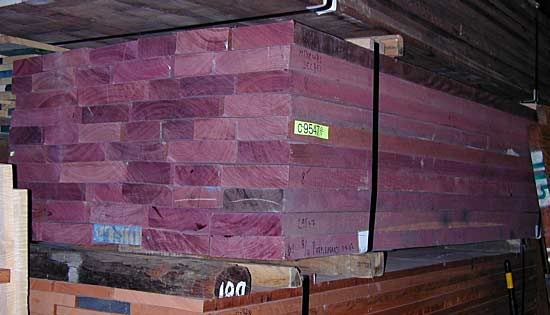 Purpleheart: The last wood I'm going to talk about today is Purpleheart. It is one of my favorite woods because it's purple and just how often do you see that? Purpleheart is amazingly heavy and dense. If you see a guitar made mostly of Purpleheart and want to buy it, start lifting weights. Sometimes PH is used for an entire guitar or bass neck and even that is enough to throw a guitar's balance way off.
 So, most of the time, you see PH used as accent stripes though the neck or body. Sometimes folks make guitar knobs out of it. You can see on this Alembic guitar how they've worked PH into the guitar body providing beautiful contrast in the woods. I have no idea how PH sounds as I've never seen a guitar made out of enough of the stuff to give me a PH "vibe." I've played some with accents and it is a gorgeous, tight grained wood. Even Ed Roman's site doesn't say too much about it. He does say it makes good fingerboard wood and that makes sense, although I've never seen it. I just had to throw it in this post because it's so cool.
Well, that wraps it up from me. There are literally thousands of species of wood out there that have been used for guitar manufacture. I could write a book on it, as others already have.
On another note, I can't believe I'm up to 10 BIAAtG posts! Woohoo!
Wednesday, December 14, 2005
Army organization and waiting to go home
Sheila’s got a post up that’s inspired me to write something about one of the most difficult times in my recent past. She was brave in baring her soul and wrote an amazing piece. I doubt I will be quite so brave, for a variety of reasons. Chief among them is that it was nowhere near as brutal to my psyche as her torturous trip was to her.
To properly understand the story I’m about to tell, I have to provide a somewhat lengthy preface. Some of the current and former military folks and military enthusiasts who visit regularly will understand what I’m talking about, but I feel that I need to explain the irregularity of my situation.
Continue reading, but I warn you, it's amazingly long.
I should start by explaining the structure of an Army company. The average or ideal company (usually designated by an alpha character A, B, C, etc.) is sized around 100-150 personnel and further broken down into three to five platoons (usually designated by a numeral 1st, 2nd, 3rd, etc.). Each platoon consists of four or five squads (numeric again) of eight or 10 people. In a combat arms unit, those squads usually consist of two, four- or five-person fire teams. Each team has a team leader who is a corporal (E-4) or sergeant (E-5). Each squad has a squad leader who is, ideally, a staff sergeant (E-6). Each platoon has a platoon sergeant who is, again, ideally, a sergeant first class (E-7) and a platoon leader, ideally, a first lieutenant (O-2). The company is led by a first sergeant (E-8) and a company commander who is a captain (O-3). There is also a company executive officer who is the company commander’s second and he is a first lieutenant (0-2).
So, in a normal company, if you are a sergeant (as I was), you would be in a squad. You would probably be a team leader. You chain of command is from you, to your squad leader, to the platoon sergeant/platoon leader, to the first sergeant/CO. They take care of soldier’s problems and work information back and forth along these channels.
Outside of this squad/platoon/company chain of command structure, there are jobs within the company that are filled by these same platoon leaders, sergeants, etc. Each company has sections that deal with personnel issues such as leave, awards, records, etc. (known as S-1); security issues such as intelligence briefings, updating and initiating security clearances (S-2); training and planning (S-3); and logistics (S-4). There are others, but these are the primary shops that company personnel deal with. Within each ‘1, ‘2 , ‘3 and ‘4 shop, there are subordinate activities. I’ll pick the ‘4 shop as it has a bunch. Underneath a company ‘4 there is Company Supply, Company Nuclear, Biological and Chemical (sometimes assigned to the ‘3 shop for God knows why) and the Company Unit Maintenance Officer/NCO. There are usually a few soldiers working in each shop.
If you’re in, say, an Infantry unit, your job is to do infantry stuff. If you’re not in the field training, or deployed doing infantry stuff (that is, bringing death and destruction to the enemy) they are maintaining equipment, etc. Usually, within the company, the folks who are acting as company personnel officer/NCO, supply, etc. are doing so as a secondary duty and are actually infantry soldiers, although, sometimes, they are actually personnel or supply-trained individuals assigned to these companies for that very specific duty.
This is not to say that company-level personnel waste tons of time doing these additional duties and such. There is usually an administrative platoon (or sometimes an entire company serving a battalion) filled with this personnel. Anyway, I stray off point.
Basically, within a company, regardless of what your real job is, be it infantry, artillery, EOD, ordnance, or finance, your unit has to fulfill the basic S-1, 2, 3, and 4 functions.
I spent an inordinate amount of time on all this to bring you all to this point: outside of combat arms, deployable, “real world” mission units, most companies in the Army aren’t set up this way. You may have only 50 people in some companies and 250 in another. Some companies don’t have platoon leaders. Some don’t have squad leaders. It’s all based on the mission of the company’s personnel. For example, at Fort Huachuca, I worked in under a Garrison Command. My company, structurally fell under said command in a convoluted fashion. It was comprised of Public Affairs, Legal, Personnel and other offices.
Now these aren’t the company-level folks, these are offices that serve the entire installation and are basically assigned to a company for administrative purposes. But the company still has to fulfill S-1 through ‘4 duties.
To shift thoughts onto my main point: The Army, in its finite wisdom, decided to create something called Public Affairs Detachments. These eight-person units are comprised of a commander, a noncommissioned officer in charge (E-6 or 7), a Public Affairs NCO (E-5), three junior-grade (E-1 to E-4) print journalists and two junior-grade broadcast journalists. This unit is designed to deploy in support of operations at a division level. Great in theory and good in practice. However, problematic when not deployed.
Here’s the issue, this little eight-person detachment, by having it’s own command element, is responsible for doing everything a “normal” company does. That is, you have to deal with personnel issues, supply, maintenance, NBC, unit movement, training and all the wealth of other issues on top of your normal PAO job (which was preparing to deploy, maintaining equipment, PAO and soldier training and supporting the Post Public Affairs Office newspaper and broadcast products). And you had to do it without any of the extra personnel a “normal” company has to do all these things.
In a logical world, in a place where common sense rules, these PADs are attached to larger companies. These companies do all the personnel, supply, maintenance issues for the PAD. The PAD’s NCOIC and commander are a tenant and provide information to that company but are generally exempt from things like Battalion Training Meetings and the umpteenth little ittty bitty things that battalions like companies to do. Unfortunately, such an environment did not exist at Fort Polk, LA, when I was the 11th PAD’s public affairs NCO.
There were several different realignments of commands and we were tossed around to different units a couple of times during my three years there, but, for the most part, we had to rely on ourselves to do a great majority of company-level “shop” stuff. I don’t want to go into it too much as I’ve already eaten up a lot of space discussing this. However, what we wound up doing was using another company’s S shop resources, but doing all the paperwork (the lion’s share of the time-consuming nonsense) ourselves.
Taking care of business this way was standard operating procedure for us at Fort Polk when we finally got the call to deploy to Afghanistan. There are a lot of cool stories I could tell about that, but basically, as a unit we attached the “garrison” element at Bagram Air Base. It was easy to get personnel, maintenance and other issues taken care of because there were shops in place to service these needs. When deployed, the Army works like it’s supposed to. At home station you see the cluster foxtrot that drives a lot of us out of the service. The political posturing and Good Ideas Of the Moment (henceforth known as GIOM) that you see every moment of every day at home station are virtually nonexistent in a deployed theater (they do happen if you’re close to the command, but no where near as bad as in garrison).
So, one of my many duties in the PAD was that of Unit Movement Officer. The person that is in charge of making sure that all the unit’s equipment and personnel are ready to go and that the paperwork is all handled correctly. This person also acts as the liaison between the Unit Movement Coordinator -- a person or office dedicated to managing all personnel and equipment inbound or outbound of theater. The person tends to be old and curmudgeonly. They don’t have any patience for you not understanding the system. They don’t understand things like, “This is an additional duty, I’ve never done this before,” or “Could you please explain to me what I need to do?”
There’s the backdrop. Here’s the where we’re at for this story: At the end of a seven-month-and-change deployment to Afghanistan we’re trying to get all the paperwork and gear in order to ship back to home station. We’re also trying to secure dates of our replacement’s arrival so we can secure the dates of our departure.
There were a couple of issues with this. First, our replacements didn’t have a warm fuzzy on their departure date, just some semi-stiff maybes. Second, our colonel in charge of PAO in Bagram wanted to ensure at least two week’s overlap so we could train our replacements.
At first, the two seemed to have little to do with one another. They would arrive in plenty of time for us to do some right seat training and we could get on our merry effin’ way. However, once we got our departure dates locked in with the curmudgeonly UMC, it quickly became apparent that their arrival and our departure dates weren’t synching. At best, they were only going to have three or four days overlap and probably not that.
The colonel’s GIOM became policy though and we had to come up with a plan. We wound up splitting up our resources. We sent home our acting NCOIC (an E-6 attached to us from Ft. Drum, NY), two print journalists, and one broadcaster; all of our equipment excluding personal gear and weapons. That left me, my commander (a super cool guy I wish I was still in contact with) and a print and broadcast journalist. The replacements came on board, my entire PAD was there to greet them for a couple of days, but then our early departers departed and the rest of us were left to teach the newcomers the ways of PAO in Bagram.
That took all of a day.
Our stuff was packed we had everything ready to go, but we spent the next several days hanging out with the new guys in case they needed more information, more help, more something … the kind of things we never got when we arrived. And, once we were cleared to leave, came four of the hardest days of my life.
Overall, the time I spent deployed to Afghanistan was pretty easy. The job wasn’t hard, tent city life was pretty plush compared to those at forward operating bases and everything was geared toward keeping stress levels as low as possible. You don’t want people freaking out in a combat zone because someone’s riding their ass about something trivial. The biggest, hardest, most difficult part is missing your way of life. Missing your family. Missing your home. Missing your bathtub. Missing your yard. Missing your horizon.
We were all missing the things that we’d signed our lives away to potentially miss. But it was the end. We were going home! But we had no idea when.
When we made arrangements for our previous members to leave, they were manifested on a dedicated flight. They had a mission number. They had to because of the amount of equipment they were carrying. We, however, since we just had personnel and our weapons/personal equipment, had to try and catch a flight on whatever was smoking out of Bagram – catch as catch can.
Trying to get manifested on flights out of a combat zone can be difficult. First of all you have to understand that these are mission flights. The primary job of these flights is not to carry personnel, but to transport equipment, etc. and whatever space there is left is given to folks to fly out. Then you have a priority list. Injured personnel have priority over anything. In fact, they will bump mission flights. Then you have people who are traveling in theater on mission. This goes on and on until you fall to the bottom of the list – second from bottom: military going home; bottom: civilians going home; oh, and the below bottom, but still on the list: civilians going on leave.
So, you wake up really, really early in the morning to get to the A/DACG (pronounced “Ay Dag” [where the C goes, I don’t know] that’s Arrival/Departure Airfield Control Group) where all the day’s flights are manifested. This is done at around 2 or 3 in the morning. Then you wait in a looooooooooong line, or you wait a looooooooooong time if you happen to be early in line and hope there’s a flight leaving that has enough room for all of your personnel.
We did this for four days. My commander and I would go down about 10 or 11 p.m. and wait until 2 or 3 a.m. to attempt to get manifested. We were, on two different days, tentatively manifested on flights. To the point that we moved all our gear down to the A/DACG only to learn that we got bumped off the one flight. The next day our manifested flight was cancelled.
I cannot explain to you the desperation one begins to feel when you are in this situation. Nothing is in your control. Everything seems left up to chance. You don’t even think about anything beyond the two or three things that you have any control over – eating, sleeping and shitting. You become zombie like waiting out time until you can let yourself hope again. And then, amazingly you’re on a plane. You get manifested – for real! You get all your personal baggage checked and palletized. You wait for the flight and then load up.
We flew from Afghanistan to Uzbekistan to Germany to Dover Air Force Base, Delaware. We took a limo (really the only big enough to hold all of us and our gear) to Philadelphia and caught a civilian flight to Alexandria, LA. Home was never so nice.
But, there was this hole in my core that those few days had drilled into me. A complete sense of hopelessness; that whatever I do, no matter how much effort I put into something, ultimately I have little effect on the eventual outcome. And that really hurt.
I’m over it now, but it took time. And that’s the last thing I wanted to address – Sheila’s assertion that time does not heal all wounds. Her belief that time in itself does not provide the catharsis for closure. I understand her point. I sympathize. But I do not agree.
She says that time leaves things jagged, and askew. Well, don’t most substantial wounds heal this way? Doesn’t a deep cut or burn leave a scar; a memory that we carry? Some worse than others.
What I guess I’m saying is that time doesn’t make things better. Time doesn’t put things right. Time closes a wound and allows you to continue operating.
A looooooooooong story
I am working on a really long story right now while dealing with some more irons that have been tossed in my fire.
Ponder this for me: My anger is white hot. Literally. It sheers through my brain like razors. When I get upset at something, I lose it. I mean, to steal a Sheila simile, I lose it like the Hulk. Oddly enough, though, I only do this at home. I don't lose my cool like this at work. I don't do it in public. But at home, man I blow my top.
Last night I realized that what was really making me mad was the fact that I was getting so mad and I didn't understand why. Logically, I fully understand that the things I get so upset about are pretty damn trivial. Were I counseling someone else, I would tell them that this behavior is unacceptable. And I know it is. What I don't know how to do is stop getting so freakin' mad.
Any suggestions?
Tuesday, December 13, 2005
Kill the Wabbit!!!
So, Stan "Tookie" Williams is dead. Thank God. Good riddance. Maybe we won't be hearing about him every other freaking minute now. Now the anti-death-penalty-pro-life-reform-commie-pinko-no-touch-with-reality-whatsoever celebrity left will have to find another high profile inmate to become the flagship of their cause.
If you can't tell, I am pro death penalty. I am so pro death penalty that I am pro slow dipping in acid. I am pro burying someone up to their neck in the desert next to a pile of red ants and pouring honey on their head. I am pro death by decompression sickness.
Mainly, I am pro a system that is so scary you don't damn want to commit a crime.
KILL THE WABBIT! KILL THE WABBIT! KILL THE WABBIT!

Cool discussion at Coalition of the Swilling
UPDATE: w/t to Suzette here's a link to the Texas Dept. of Corrections listing of executed offenders. It lists them, their offense and their last statements. Powerful, moving stuff.
If you can't tell, I am pro death penalty. I am so pro death penalty that I am pro slow dipping in acid. I am pro burying someone up to their neck in the desert next to a pile of red ants and pouring honey on their head. I am pro death by decompression sickness.
Mainly, I am pro a system that is so scary you don't damn want to commit a crime.
KILL THE WABBIT! KILL THE WABBIT! KILL THE WABBIT!
Cool discussion at Coalition of the Swilling
UPDATE: w/t to Suzette here's a link to the Texas Dept. of Corrections listing of executed offenders. It lists them, their offense and their last statements. Powerful, moving stuff.
Quotational Mojo
I'm stealing some Mojo from Suzette and some therapy from Will.
When I realized the other day that my throwing out my back was due primarily to stress and weight, it was also a wake up call for my lifestyle. I must eat better. I must drink more water. I must exercise.
I have said these things before, recently, but I now have a plan. I am enacting subtle changes to my life in steady increments so as to not shock the system -- at first anyway. Not staying chained to my desk at the office is one of those ways. Taking short walks at lunch, as weather permits, is another. There will be more changes, but these are baby steps as I can't seem to break myself from my current routine.
On that note, here's a favorite quote of mine that has helped me in the past when I'm about to embark on a difficult journey or task:
It will be difficult at first, but everything is difficult at first.
- Miyamoto Musashi
Monday, December 12, 2005
Moving slowly
While I don't usually post much, if anything, over the weekend, this particular one was pretty bad for me. I threw my back out Friday and spent the majority of Friday and all of Saturday in bed, doped up. It's a recurring problem and I do it pretty often.
I went to the chiropracter Friday and found out it was a muscle sprain that causes my problems. Which is more than any doctor in the military ever told me since I first injured it about 8 years ago. We didn't go into causes, however I'm fairly certain the reinjuring is both stress and weight related. More reasons to get back in shape. Dammit.
Anyway I'm doing better today and was yesterday also. Just moving a bit more slowly.
Friday, December 09, 2005
Because I'm All About the Guitar Pt. 9: BuildingRebuilding a guitar
 I was inspired by a post from the CosmicConservative. I was bitten by the "want to build my own guitar" bug a couple of years ago.
I was deployed to Afghanistan. When not extraordinarily busy, we were extraordinarily bored. So, while attempting to alleviate the boredom through looking around for time-consuming internet sites, I landed on Ed Roman Guitars. Ed Roman goes a long way to detail construction techniques and woods used, etc. on his guitars. It's enough to whet you appetite for construction.
I did some searching. I wound up finding the Musical Instrument Maker's Forum where there is so much knowledge about guitar construction. But I'm stuck deployed to Afghanistan so it's not as though I can just start building something.
Then I get home. And I have the bug. But I don't have the money to invest in any of this. The tools are expensive. The wood is espensive. The parts are expensive. Anyone who thinks they are going to save money by building their own guitar is fooling themselves. Any mistake and you might very well have to start over from the beginning. The time and effort along with the money you'll spend can add up to several times what you'd pay for an off-the-shelf Les Paul.
Instead of building something from new. I decided to dig out some old parts I had lying around. It's very similar to the '80s-era Kramer Barretta I have pictured here. It's a dual cutaway, single pickup guitar. The spare body I have is more sharp on the cutaway horns, more like a Jackson soloist. My headstock is not a "hockey stick" style like the Kramer either, nor do I have a Floyd Rose trem system. But, otherwise, it's very similar.
It's been years since I decided to work on this and I've accomplished very little. I've stripped all the old paint off the neck and body. I've ordered some new machine tuning heads ... that's about it. I still haven't decided exactly what I want to do. I'm debating filling in the tremolo cavity (it's got a Fender-style trem) and putting on a Fender-style non-trem bridge. But I don't know. What this really is is an exercise in guitar "construction." I mean, it's always nice to have another playable guitar around, but I don't really need it. I just need to see if I can do it.
Thursday, December 08, 2005
Best album ever!
Bingley's got up a post about the best year in music. He makes a compelling argument about 1979, although we all know that 1991 was truly the best year.
While the year might be somewhat debatable, it brought to mind what is the best album ever? What album is so perfect that it has no faults. I can think of few contenders, but there's only one champion:
Dream Theater's 1999 release: Metropolis 2: Scenes From a Memory

While the year might be somewhat debatable, it brought to mind what is the best album ever? What album is so perfect that it has no faults. I can think of few contenders, but there's only one champion:
Dream Theater's 1999 release: Metropolis 2: Scenes From a Memory
More meme: Facts
1. My uncle once: snapped a car door off its hinges to pull somebody out of a car. He was a violent dude sometimes.
2. Never in my life: have I jumped out of an airplane. I was asked if I wanted to go to Airborne school many times while I was in the Army. I always answered an emphatic, “No!”
3. When I was five: I lived in Great Fall, Montana and my brother was born.
4. High School is: four years long. If you’re lucky.
5. My parents are: polar opposites. My mom is a timid, polite person with an odd sense of humor. My dad is a short, loud, quick-to-anger man with a great sense of humor.
6. I once met: former Vice President, presidential hopeful and former ambassador to Japan, Walter Mondale. He attended a special event we were holding on our installation on Okinawa. He was drunk.
7. There's this girl I know who: … um know or knew? I don’t know many girls any more. I knew this girl who was convinced she could tell the future, not like, divine the future from Tarot cards or a crystal ball, but rather just look at you and tell your future. She couldn’t.
8. Once, at a bar: wouldn’t you like to know.
9. Last night: I re-watched Lost and had a fantastic homemade pot pie.
10. Next time I go to church: will be when my kids are doing some special program or something.
11. When I turn my head left, I see: My credenza, which holds a bunch of recorded CD archives of our newspaper, my phone, my reference books (AP Styleguide, etc.).
12. When I turn my head right, I see: My right return on my desk. I has my desk calendar and is where I read papers and such.
13. How many days until my birthday?: 26 days.
14. If I was a character written by Shakespeare I'd be: I can’t begin to analyze myself through Shakespeare. Probably somebody in a crowd somewhere.
15. By this time next year: it will be one year later.
16. A better name for me would be: I like my name, which is actually my middle name.
17. I have a hard time understanding: how anyone could think more federal government could help ANYTHING, much less health care or other social programs. (I can’t say it any better than this. Thanks Lisa).
18. If I ever go back to school I: I'd be a lawyer (also stolen from Lisa). I almost got out of the Army at my four-year mark to do this very thing.
19. You know I like you if: I go out of my way to show you something or prove something to you.
20. If I won an award, the first person I'd thank would be: my wife and kids.
21. Take my advice: being an enlisted man is easier on the soul; being an officer is easier on the pocketbook.
22. My ideal breakfast is: Black coffee.
23. If you visit my hometown: you’ll probably drive right through it and not even know.
24. Why won't someone: shut Sean Penn up?
25. If you spend the night at my house: you’ll sleep in my baby’s room on a pretty nice futon.
26. I'd stop my wedding: … um, a bit late, but I guess if something tragic happened.
27. The world could do without: $cientology, Tom Cruise, et al.
28. I'd rather lick the belly of a cockroach than: lick the belly of a slug.
29. Paper clips are more useful than: staples. While staples are more permanent, they don’t have near the amount of uses as a paper clip.
30. If I do anything well, it is: procrastinating.
31. And by the way: if you must use your cell phone in your car, MAKE SURE YOU HAVE A HANDS-FREE DEVICE! Dammit.
w/t to Lisa, via Sheila.
Today we lost an amazing musician
Today is the anniversay of the death of an amazing musician. Someone who changed the face of music. Whose presence on stage and off inspired a new generation of musicians around the world.
Yes, that's right, it's the one-year anniversary of the death of "Dimebag" Darrell Abbott.
I remember the first time I heard Pantera. I saw the Cemetery Gates video on Headbanger's Ball. Their sound fundamentally changed the way I listened to heavy metal. When you hear Pantera, you immediately understand how intense music can be. You expect it. They reset the bar.
The world is a sadder place without him. Rest in peace.
Thursday Travelogue: Garden of the Gods
 Some things, some places seem more monumental (pun intended) when revisted through the child's filter of your mind's eye. While it may truly be amazing, there's something about memory, especially if it's from childhood, that adds some magic to the ordinary.
When I was around 10 years old, my family was stationed at Peterson AFB, Colorado Springs. At the time, my dad was quite the outdoorsman. We camped and fished at different times throughout the year. We would also make trips out to local parks and tourist traps. One of those was Garden of the Gods.
 I've always had a thing for rocks. Don't know why, but I like 'em. I like the way some are smooth and some are rough. I like the way light catches them differently at different angles. There was a time, when I was about 6 or 7, that I had a bunch of rocks on our front porch, in the sunlight. My dad told me to get all the rocks off the porch. I asked him, "But how are they going to grow into big rocks?" Yeah, yeah, I was a silly kid. But I loved rocks.
Anyway, for this installment, I wanted to pull something from my childhood and Garden of the Gods seemed like a good idea. However, looking at the photos I've found online, the park isn't as grand as I remember. I mean, it's a beautiful place, but after you've been to the Grand Canyon, Sedona and Chiricahua, you're ruined on scenic rocks.
It still has a special place in my mind. Colorado Springs and Peterson AFB in general do as well, but the Garden was always a special trip. We went several times over the three years we lived there. It was a special treat. Not only to play outside around the rocks with my younger brother, but inside the gift shop they had two things I also sought -- fool's gold and polished stones. I had a good collection of both from all the times we visited.
My parents weren't the kind to spend a lot of time explaining the importance of the monuments to us. They answered questions and would give cursory explanations. But this place was still treat to visit. It's still a treasured place in my mind. It makes me realize that doing things with my children is important regardless of what we actually do.
Ed. Note: None of the photos here are mine. I found them online. Because of where I found them, I consider them to be in the public domain. However, if one of these photos is your property and you object to its use here, please leave a comment and I'll remove it.
Wednesday, December 07, 2005
A day that will live in infamy
The Japanese attack on Pearl Harbor:

There are all kinds of political, historic, and apologist rhetoric surrounding the remembrance of this event. But, what it boils down to is that they bombed us, we went to war, we kicked ass. The end.
Take a moment today to thank a veteran. Take a moment to think about this great evil we helped stop. A great evil unparalleled until today.
Remember Pearl Harbor. And for God's sake don't watch that horrible movie, watch Tora! Tora! Tora! or something.
Tuesday, December 06, 2005
An amazing poem ...
"Patient and steady with all he must bear,
Ready to accept every challenge with care,
Easy in manner, yet solid as steel,
Strong in his faith, refreshingly real,
Isn't afraid to propose what is bold,
Doesn't conform to the usual mold,
Eyes that have foresight, for hindsight wont do,
Never back down when he sees what is true,
Tells it all straight, and means it all too,
Going forward and knowing he's right,
Even when doubted for why he would fight,
Over and over he makes his case clear,
Reaching to touch the ones who won't hear,
Growing in strength, he won't be unnerved,
Ever assuring he'll stand by his word,
Wanting the world to join his firm stand,
Bracing for war, but praying for peace,
Using his power so evil will cease:
So much a leader and worthy of trust,
Here stands a man who will do what he must."
... but Pakistan doesn't think so.
Here's looking at you Charlie Brown
 ABC's running A Charlie Brown Christmas tonight at 8 Eastern. In honor of that, find out some little known facts about the show, and test your knowledge.
I scored 80%.
MMORPG more social than BBQ?
I'm not sure I believe all thier claims, but this is still an interesting commentary about online gaming.
w/t Dean's World.
w/t Dean's World.
It's my busy day
I don't imagine that I'll be around much today as it's my busy day at work.
So, in there interest of keeping things humorous, I present:
Unnecessary bleeping (courtesy of the Jimmy Kimmel show).
So, in there interest of keeping things humorous, I present:
Unnecessary bleeping (courtesy of the Jimmy Kimmel show).
Monday, December 05, 2005
It's beginning to look a lot like Christmas
This weekend was the "get the house in order for Christmas" weekend in my household. I rearranged the living room (just because I wanted to, but it was part of the weekend's goings on) and cleaned up our book/music room and got the tree up.

Both of those bookshelves on the side, and one off camera in another corner, had books haphazardly thrown on them and other junk stuffed on them in various places. I knew when I originally just threw the books up there that I was going to have to organize them eventually. I never realized what a task that was going to be.
Anyway, got all the cleaning done, set up the tree (above) and the rest of the family decorated it.
 They did a pretty good job. I particularly like how my youngest daughter decided to put of row of ornaments along the bottom of the tree. Too funny.
Well, I'm not a huge Christmas fan, but I'm no Scrooge either. So, it's finally starting to feel like Christmas time to me. Even though it's still hot enough here to be running the air conditioner.
Both of those bookshelves on the side, and one off camera in another corner, had books haphazardly thrown on them and other junk stuffed on them in various places. I knew when I originally just threw the books up there that I was going to have to organize them eventually. I never realized what a task that was going to be.
Anyway, got all the cleaning done, set up the tree (above) and the rest of the family decorated it.
They did a pretty good job. I particularly like how my youngest daughter decided to put of row of ornaments along the bottom of the tree. Too funny.Well, I'm not a huge Christmas fan, but I'm no Scrooge either. So, it's finally starting to feel like Christmas time to me. Even though it's still hot enough here to be running the air conditioner.
Friday, December 02, 2005
Because I'm All About the Guitar Pt. 8: G3 2005
 I have been burning out my computer/car/home stereo speakers and DVD player the past week with the sonic assault that this year's G3 has presented. This year the trio included mainstays Satch and Vai and the rotating third guitarist was John Petrucci. Those who read my last BIAAtG post know I'm a huge fan of Petrucci, so this was a great G3 year for me.
For those who don't know about G3, it was started in 1996 by Joe Satriani to offer a mega guitar-centric concert to audiences around the globe. That first line-up was Satch, Vai and Eric Johnson. Most line-ups through the years feature Satch and Vai as the primaries, but there were a couple of years where Vai was absent. Anywho, every G3 show is packed with yummy guitar goodness. If you've never heard or seen a show, pick up a CD or DVD. Great shows.
The CD is amazing. The music is wonderful, but only the last three songs -- the G3 jam -- presents you with something you've never heard before (if you're familiar with the artist's work).
The DVD is also great, but not as explosive as past shows -- particularly the 2003 show with Yngwie "The Fookin' Fury" Malmsteen. Individually, this year, each guitarist put on great performances of their material, but the G3 jam at the end (performing Foxy Lady, La Grange and Smoke on the Water together) just didn't have some of the energy that past shows have displayed. I think this has something to do with personality. Vai is a performer. An electric presence. Satch is solid, aware and plays to the audience. Both of them feed of the energy of their third compatriot. And this is where we lose some of the show. John Petrucci is my favorite guitarist, but he is a pretty stationary stage presence. Very laid back -- which seems to speak of his personality. No matter how fantastic a guitarist the guy is, he has remained humble and very respectful of his fans. Same can be said of Satch and Vai, but on a different kind of level.
All in all, the DVD is enjoyable, but if you just want to hear cool jams, pick up the CD. The DVD is for "troo" fans.

Both of these photos are from www.johnpetrucci.com 'cause he is not only a great guitarist and cool guy, but has a fantastic website.
Thursday, December 01, 2005
Barely any time: Something to put up
W/T to Nightfly
Fly, believes that Showgirls is just crap, not cult. While it may be crap, it has definitely established it's own cult.
| The Movie Of Your Life Is A Cult Classic |
 Quirky, offbeat, and even a little campy - your life appeals to a select few. But if someone's obsessed with you, look out! Your fans are downright freaky. Your best movie matches: Office Space, Showgirls, The Big Lebowski |
Fly, believes that Showgirls is just crap, not cult. While it may be crap, it has definitely established it's own cult.
Subscribe to:
Posts (Atom)